What it adds to CAP
PACELC extends the CAP discussion by making the trade-off outside a network partition explicit:
- If there is a Partition (P): choose between stronger Availability (A) and stronger Consistency (C) for affected operations.
- Else (E), when the system is operating without a partition: choose between lower Latency (L) and stronger Consistency (C).
A system may need coordination among replicas to provide a stronger consistency guarantee, which can add latency. Relaxing coordination can reduce response time, but may allow reads to observe older data. PACELC is a way to frame these trade-offs; it does not replace a system’s detailed consistency model or mean every request follows one global, fixed choice.
Reading the diagram
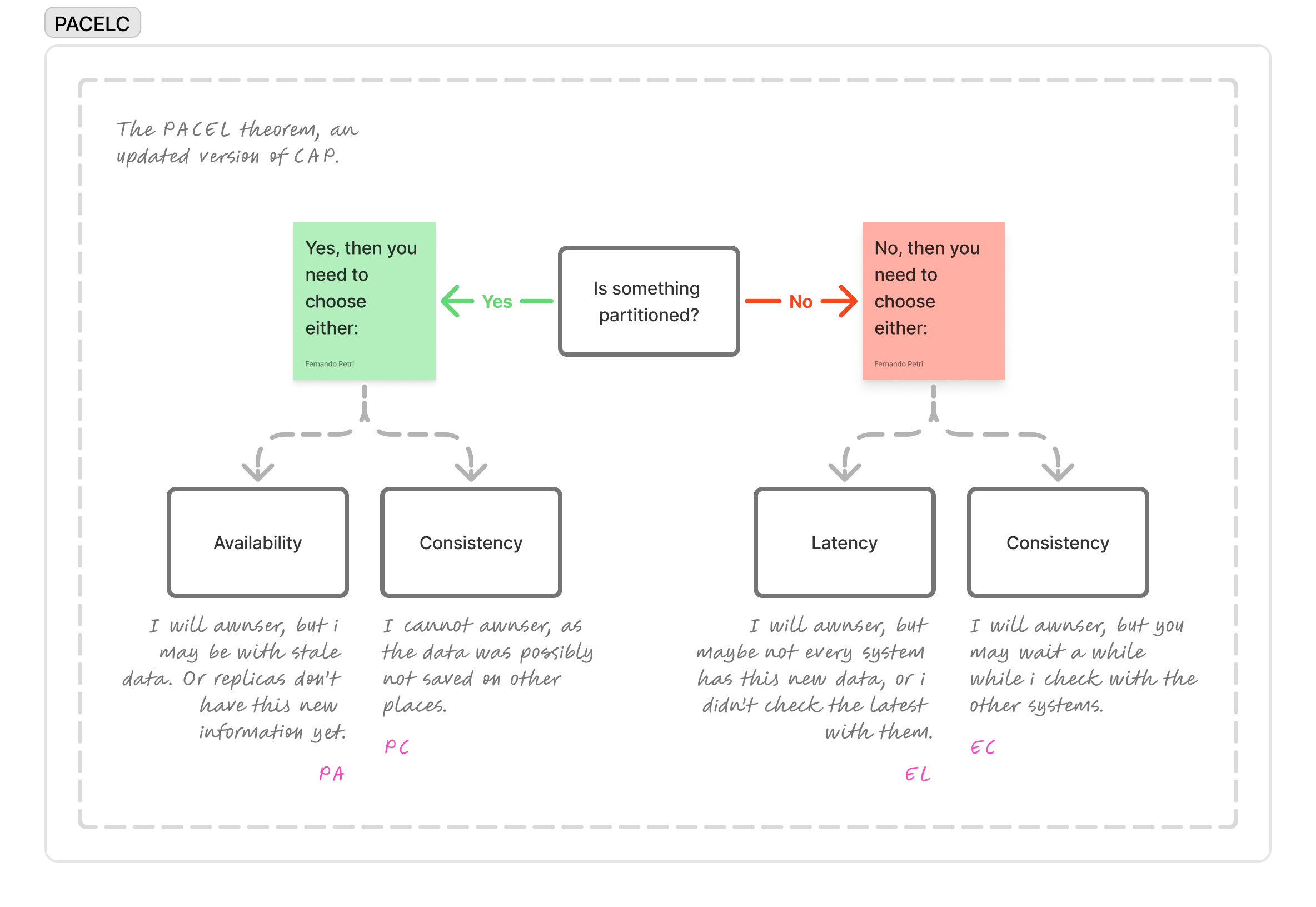
Start with the question “Is something partitioned?” If yes, the diagram highlights the CAP availability-versus-consistency decision. If no, it highlights the latency-versus-consistency decision. The real behavior can vary by read/write path, configuration, and failure mode, so verify the guarantees of the specific database or service.
When it is useful
Use PACELC when comparing distributed data systems or designing a request path. In addition to asking what happens during a partition, ask what coordination costs in the healthy case and whether the resulting latency and freshness are acceptable for the workload.
See also: CAP theorem · Databases · System Design