What it says
The CAP theorem describes a limit on distributed data systems when a network partition prevents some nodes from communicating. During a partition, a system cannot guarantee both:
- Consistency (C): every successful read observes the latest completed write, as if there were one copy of the data (linearizability).
- Availability (A): every request to a non-failing node eventually receives a response, even if that response may not contain the latest write.
- Partition tolerance (P): the system continues operating despite messages being lost or delayed enough to split nodes into groups that cannot communicate.
The important point is not that a system can permanently “pick any two.” Partitions are a failure condition: when one occurs, the design must decide which guarantee to relax for affected operations. CP systems may reject or delay some requests to preserve consistency; AP systems may answer with potentially stale or conflicting data and reconcile later. The exact behavior depends on the system and operation.
“Consistency” here means a distributed-systems consistency guarantee such as linearizability; it is not the same as the C in database ACID. And CAP does not say that availability and consistency are mutually exclusive during normal, partition-free operation.
Reading the diagram
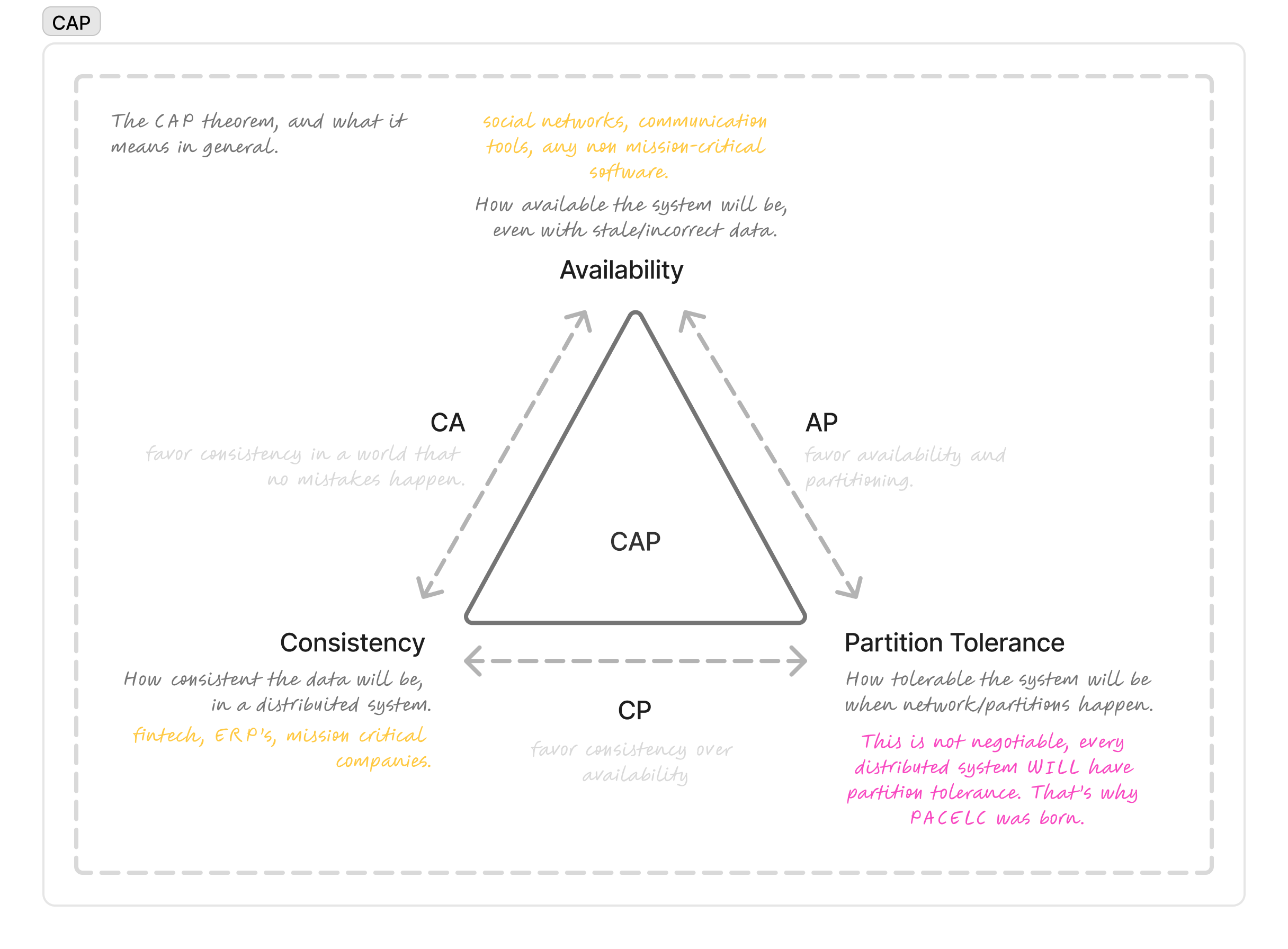
The diagram’s dashed arrows contrast the pairwise combinations. CA can describe a system while communication is intact, but it does not meet the partition-tolerance requirement. During a partition, CP and AP are shorthand for which guarantee a design prioritizes for affected operations: CP may refuse some requests to preserve consistency; AP may answer while allowing stale data or later reconciliation. In a real distributed deployment, partition tolerance is not something one can simply switch off.
When it is useful
Use CAP as a reminder to make failure behavior explicit. Ask what reads and writes should do when replicas cannot coordinate: return quickly with possibly stale data, or wait/fail rather than risk a stale answer? The answer is a product and correctness decision, not a label to assign to an entire database without checking its guarantees.
See also: PACELC · Databases · System Design